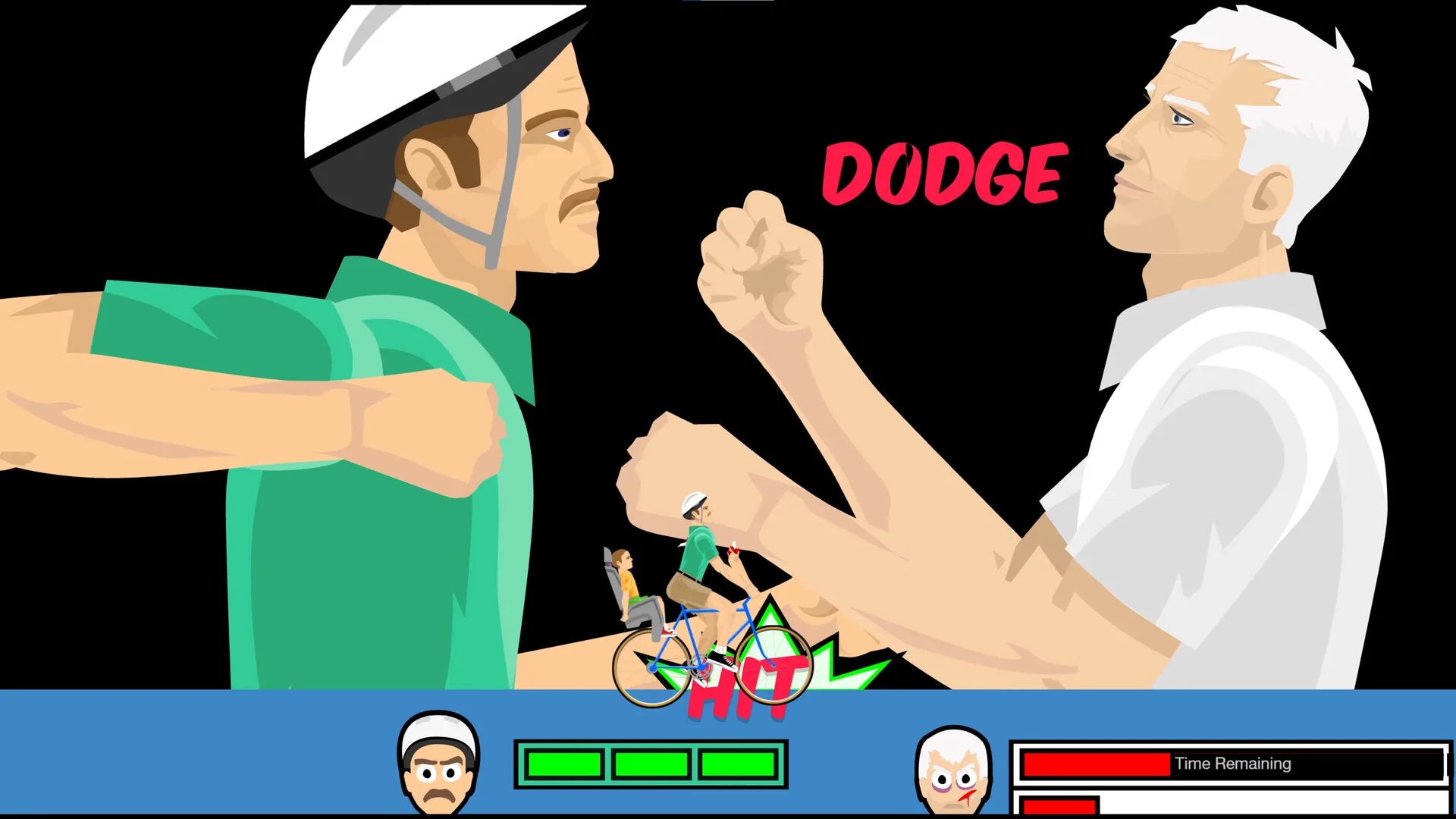
There is no health bar
Happy Wheels does not give the player a health number. Damage is expressed physically: limbs detach, the vehicle breaks apart, and the character model changes shape. Reviewers have described the game’s violence as its signature, and the Steam store page’s own content description calls it “satirical cartoon violence” with exaggerated injuries such as dismemberment and bleeding.
The important consequence is that “how hurt am I” is a visual question, not a numeric one. You read your character’s body instead of a bar.
What keeps you alive
A character remains controllable as long as the head is attached and the torso still exists. Practically:
| State | Still controllable? | Effect |
|---|---|---|
| Minor injuries, limbs intact | Yes | Almost no change |
| One or more limbs lost | Yes | Harder to steer, harder to balance, harder to crawl |
| Vehicle destroyed | Yes | You are on foot, which is slow |
| Decapitated | No | Run over, input no longer matters |
| Torso destroyed | No | Run over |
This is why experienced players keep going after a catastrophic-looking failure. Losing both arms mid-level is survivable, and a limbless character can still slide over a finish line.
The heart, and the camera
One documented detail explains a lot of confusing moments: the in-game camera normally follows your character, but if the torso is destroyed the camera switches to tracking the heart. The camera only locks in place if the heart itself is gone. When you lose a level and the view seems to jump to a small object, that is the heart, not a bug.
Damage sources you will meet
Hazards in Happy Wheels are physical objects, and the same object behaves differently depending on speed and angle:
- Spikes and spike sets — impale rather than cut. Slower approaches are often survivable-ish; fast ones are not.
- Blades and blade weapons — remove limbs.
- Harpoon guns, arrow guns and cannons — fire projectiles that can pin a character to scenery.
- Mines and homing mines — explosive, and often used as a level’s “gotcha” moment.
- Wrecking balls and other heavy objects — crush and launch.
- The level itself — falling off the map, or having a moving platform close on you.
Because the physics engine is shared and consistent, mastering why an object hurt you is more useful than memorising where it is. A gap you cleared at full speed may kill you at walking speed, and vice versa.
Finishing while damaged
There are several Steam achievements built entirely around finishing a level in a terrible state, which confirms that these states are survivable by design. Examples from the achievement list include finishing with arrows embedded in your body, finishing without limbs, finishing after being impaled by a spike, and finishing before bleeding out.
The lesson: when everything has gone wrong, keep steering toward the goal. The level is often still winnable.
Gore as a mechanic, not decoration
The game’s violence is not a separate layer painted on top of the physics. The dismemberment system is the fail-and-partial-fail model, and it doubles as the scoring model for many achievements — counting limbs lost, heads crushed, vertebrae exposed and so on. That is why the achievements read like a body-count tally rather than a checklist of level names.
If you want the gentler end of the game, the mobile versions historically shipped an option to reduce blood in the advanced options menu. The Steam store page’s content description remains the authoritative statement on what the game contains.
Related reading
- How to play for the goal types you are trying to reach in this state.
- Achievements for the full list of damage-themed unlocks.