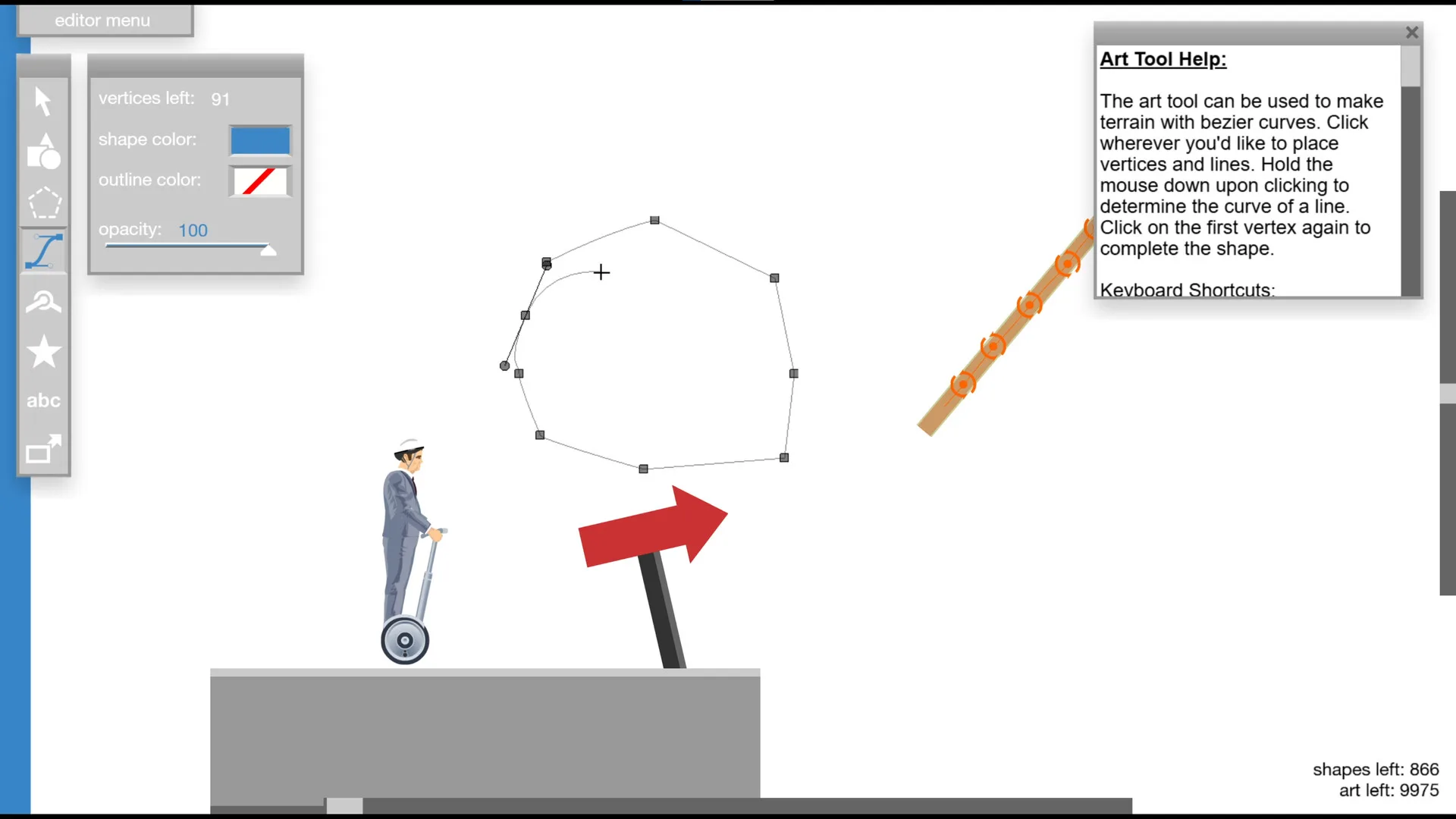
The editor is organised around a small number of tools and a much larger catalogue of objects. This page is a reference rather than a tutorial — see editor basics for the build order and advanced techniques for putting them together.
The tools
| Tool | What it does |
|---|---|
| Shape tools | Place the geometry of the level. Circles and rectangles have documented minimum sizes, and polygons are the flexible option. |
| Art tool | Draw decorative art. Consumes the separate art budget rather than the shape budget. |
| Vehicle tool | Place vehicles. Vehicles count as a game feature, not as artwork. |
| Joint tool | Connect objects so they move together. The pin joint is the workhorse. |
| Trigger tool | Fire scripted events in response to player action. |
| Backgrounds | Set the level backdrop and colour from the level options menu. |
Sizing limits worth knowing
The wiki documents the smallest possible polygon triangle as 2 x 2, and the largest possible polygon as 20,000 x 10,000 — the entire stage. Shapes made with the shape tool have their own bounds, from a 5 x 5 circle up to a 5,000 x 5,000 rectangle.
The practical takeaway: polygons give you both extremes, so they are the tool to reach for when the shape tool will not cooperate.
Hazards
Hazards are where a level gets its teeth. Documented categories include:
- Spikes and spike sets — the classic impaling hazard
- Blades and blade weapons — the dismemberment tools
- Cannons — firing large projectiles
- Harpoon guns and arrow guns — firing projectiles that can pin a character
- Mines and homing mines — explosive, and often used as an unannounced trap
- Wrecking balls — heavy swing hazards
- Landmines and similar placed explosives
Because the physics is consistent, the same hazard behaves differently at different approach speeds. That is the main lever a level designer has: a spike wall is a puzzle at slow speed and an execution at high speed.
Objects and props
The catalogue is large, and it is split into functional and decorative groups.
Structural items include glass panels, I-beams, chains, strings, ropes, bridges and building blocks. Glass panels are notable because they are breakable, which makes them a pacing tool — the player can see the route through them.
Platform items include spring platforms, paddle platforms and speed bridges. These are how creators build vertical sections without relying on the player’s jump.
Props and scene objects include tables, chairs, toilets, televisions and the broad “food items” and “body parts” groups that the game uses for its humour. Some of these are load-bearing for achievements: the mower-related achievements require mowing fruit, torsos and brains, which means creators deliberately place those objects in front of a lawnmower.
Vehicle-specific items include the rails used by Explorer Guy. Rails turn the mine cart into a completely different movement system, and they are the only way to build a proper rail section.
Sound and text
Two objects are commonly underestimated:
- Text — allows in-level messages, titles and instructions. The community documentation notes it is used for things as simple as labelling a section, which is genuinely how some featured levels communicate with the player.
- Sound triggers — a documented set of sounds that can be played from the trigger tool. This is how levels get stingers, ambience and rewards.
Custom creations: what the community builds
The wiki documents a category of popular user-made creations — contraptions assembled from existing objects rather than placed as single items. The best-known example is the chomper (also called a snapper, scissors or clapper): two interactive items, often blade weapons, connected at the back with a pin joint. When it latches onto the player, it tears them apart.
That single example explains the whole category. There is no “chomper” object in the editor. A creator built it from two objects and a joint, and the idea spread because it worked.
The shape budget is the real constraint
Remember the documented 900 shape limit while placing objects. Most ambitious levels run out of shapes long before they run out of ideas, and the standard solution is to simplify geometry rather than to add more detail.
Related reading
- Level editor basics — stage, limits and build order.
- Advanced editor techniques — joints, contraptions and scripting.